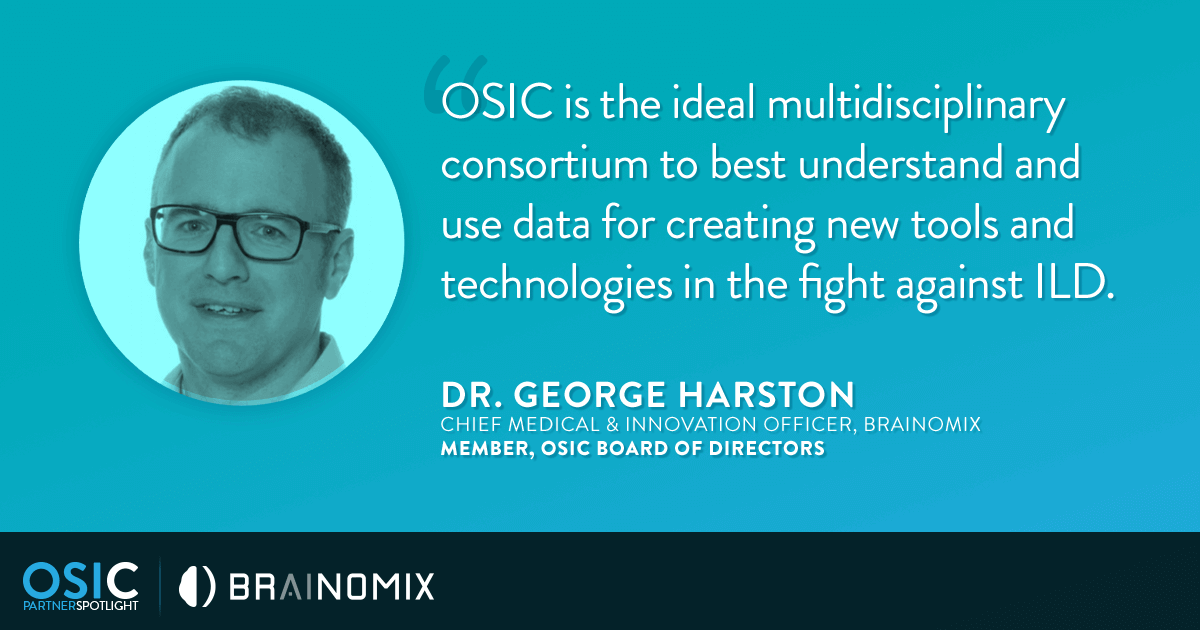
A Q&A with Dr. George Harston
You’ve been a part of OSIC since the beginning. What are you most proud of accomplishing so far?
There is a growing need for more accurate and reproducible assessment and quantification of ILDs. In response to this need, we’ve developed e-ILD, a state-of-the-art software tool to describe and quantify the pattern and behavior of fibrosis in ILDs. It has been shown to outperform conventional measures (lung physiology, FVC), adding complementary useful information from the scans and offering an exciting opportunity to improve the way new treatments for ILDs are tested.
Working with the anonymized HRCT scans and accompanying clinical data from the OSIC Data Repository will help us refine and validate our e-ILD technology to translate it into both clinical trials and clinical practice to improve the treatment of fibrosing lung diseases. We remain excited and optimistic about the advances that we can make together in the treatment of fibrosing lung disease.
What drew you to OSIC? What is it that you believe makes this collaboration so valuable?
It is impossible to treat a condition you do not fully understand. OSIC brings together a unique constellation of expertise from healthcare, academia and industry, enabling not only the creation of a unique dataset, but also the sharing of knowledge and know-how. OSIC provides the multidisciplinary consortium to understand the data and how to best use it to create new tools and technologies in the fight against ILD.
If you had a crystal ball, what do you think OSIC will have accomplished in five years?
It will have catalyzed the transformation of how we approach the treatment of fibrosing lung diseases, both in clinical trials and clinical practice. We are excited to continue our collaboration with other world-leading experts to achieve groundbreaking advancements for patients.